Sacred Honey Bee Evening video clip, CLICK ON THE PHOTO TO VIEW

Sacred Honey Bee Evening video clip, CLICK ON THE PHOTO TO VIEW
Click on this photo for a video of "Evening in Honor of the Sacred Honey Bee". Photo by Daniel Bahmani

Search This Blog

Sunday, May 8, 2011

The BUZZ: Mark Your Calendars for the Great Bee Count on July 16th!


Greetings citizen scientists! I know that some of you who live in warmer climates are already sending in your 15 minute observations and others will be doing so throughout the year.
This year, however, we would like everyone - even those of you who haven’t sent in observations – to make the effort to join the Great Bee Count of 2011 on July 16th. The best way to sample is to sample every other week but if you only count bees once this year, make it on July 16.

Now more than ever, bee populations are endangered. The more we know about pollinator service across the country, the more action will be able to be taken to preserve and enhance pollinator habitat. We’re joining together to learn more, and we’re taking time to share what we’ve observed.

In most areas, it takes between 8 - 10 weeks for sunflowers to bloom from seed. Now is the time to plant if you have not done so already! If you order seeds from Renee’s Garden, (enter coupon code FR225A so that part of the proceeds go to our project) and get your seeds in the ground this week. By doing so, you will be in good shape to have sunflowers for your July 16th observation.

Take a moment now to mark your calendars for the Great Bee Count. In the next weeks I’ll be sharing information on growing your sunflowers and answering questions about making your observations, so that when July 16th rolls around, we’ll be all set to hunt for bees! (Plus we’ll send a reminder or two.)

Make a difference in what we know about pollinator service. Be a part of the Great Bee Count on July 16th! In this small way, a great change can take place.

Best,

Freddy B
©2011 The Great Sunflower Project | San Francisco State University | 1600 Holloway Avenue | San Francisco | 94132

Sunday, April 24, 2011

Beekeeping Project Empowers Peruvian Indigenous Group


When he goes to visit the Maijuna people in the Peruvian Amazon, Mason student German Perilla is welcomed by the name they gave him — “ua” — which means, simply, “bee.”

An appropriate name, given that last year Perilla brought more than 600,000 honeybees to their small community as part of a beekeeping program through his studies at Mason. Perilla is pursuing a master’s degree in interdisciplinary studies, with a focus in environmental science and community engagement.

Tucked away in a remote part of the northeastern Peruvian Amazon, the Maijuna Indians are a very isolated group of forest-dwellers. Today, there are approximately 400 Maijuna individuals living in four communities. Perilla began working with the Maijuna through Mason professor Michael Gilmore, an ethnobiologist who’s been working with the Maijuna for many years and helping them maintain their cultural, biological and ecological traditions.

Twice a year, Perilla travels to the Amazon to do workshops and classes with the Maijuna. It’s not an easy journey. After a nine-hour plane ride to Iquitos, the capital of the Peruvian Amazon, Perilla then travels by boat for almost 24 hours to reach Maijuna lands.

Once there, Perilla teaches the beekeepers about the biology, ecology and behavior of bees, the flowering cycle of jungle plants and practical management of the hives. The group will also learn how to harvest honey and wax and make products such as candles, jams and creams.

Love at First Sight
Ever since he first started working with bees, Perilla was, well, stung by the idea.

“The very moment we opened the hive, it was love at first sight. I’ve been working with bees ever since,” he says.

Perilla has worked on beekeeping projects all over the world. As part of the United Nations Solidarity Network in his home country of Colombia, Perilla worked with refugees of war, showing them economic opportunities with bees and small animals. In Israel, he participated in the Bees for Rural Development program.

His Maijuna beekeeping project is funded in part by the Rainforest Conservation Fund and Mason’s New Century College, as well as by private donations.

Gilmore says that Perilla’s project is perfect in many ways.

“I’m most excited about the fact that the Maijuna can use the beekeeping project for income, but still maintain their traditional lifestyle,” he says. “The bees will provide an economic means to these communities without causing any environmental destruction.”
Empowering a Community

But perhaps the most important component of the project is the community empowerment it provides.

Many of the older Maijuna do not know how to read or write, but this program allows them to provide for their families and communities. Perilla is also helping the community develop a co-operative to which the beekeepers will sell all their raw materials wholesale. The co-op will then make all the byproducts, market and promote their products and resell them to consumers.

“They have to learn to relate commercially to their product and learn about taxes and law,” says Perilla, who is passionate about training the Maijuna not only how to work with bees but also how to have confidence and power.

“One of the failures I’ve found in these types of programs is that they’ll train them to be beekeepers. And that’s it. That doesn’t work.”

The co-operative will allow the communities to earn money that they can use for needed services such as medical care, school supplies and clothing. Perilla and Gilmore are also helping the Maijuna on a greater scale to protect their ancestral land from government development and outside poachers by giving them the confidence to control their own destiny.

“They are incredibly involved in the project,” says Gilmore. “German is excited about this project, and the Maijuna are, too. They view the project as their own, and that’s really important and central to the goals of this project.”

Says Perilla: “For me, it has been a real fulfillment of life. You can really make a difference there, and that is what is important to me. Conditions may be harsh in many respects, but the satisfaction you get from doing this is worth it. Whatever it is, I’m contributing to saving the Amazon and empowering these people, so I’m proud of this moment.”

Saturday, April 16, 2011

Kids' Bumblebee Study Creates Buzz in Science Journal

Buff-tailed bumblebee (Bombus terrestris)
Getty Images

A study published in the prominent British science journal Biology Letters has discovered that bumblebees "can use a combination of color and spatial relationships in deciding which color of flower to forage from." And also, that "science is cool and fun because you get to do stuff that no one has ever done before."

Those were the conclusions reached by the study's authors, who are almost all between the ages of 8 and 10. The students at the Blackawton Primary School in Britain observed local bees and found them capable of using color patterns to find the sweetest flower.

Young researchers at Blackawton Primary School in Britain discovered that buff-tailed bumblebees can use color patterns to find the sweetest flower.
Study researchers from the U.K.'s Royal Society called their conclusion a "genuine advance" in bee science.

"This paper represents a world first in high-quality scientific publishing," Brian Charlesworth, editor of Biology Letters, told the BBC. The students worked with their teachers and a professional (i.e., adult) scientist, Beau Lotto. But Lotto said the study was "entirely conceived and written" by the students, according to the BBC.

And indeed, the study has traces of its pint-sized authors everywhere, from the colored pencil the kids used to demonstrate patterns in the bees' behavior, to peppered references to the novel nature of their work. "This experiment is important, because, as far as we know, no one in history (including adults) has done this experiment before," the students wrote in the study.

Sponsored Links
The kids even used puzzles to get to the question at the center of their study: Can bees figure out which flowers have salt water in them and which have sugar water instead? They can, the students concluded.

Lotto said that while the study lacked statistical analysis, "the experimenters have asked a scientific question and answered it well," according to The Guardian. He said that while the students at Blackawton are impressive, children around the world should have the opportunity to work on such projects.

"I certainly don't think this is something that only we could have done. It's something that lots of schools could do," he told Wired.com. "It would be lovely to have this sense of community around learning all over the country and all over the world."

The Honey Bee Colonies are ok again. Joy! (a commentary ---decide for yourself whether or not you agree....my comment at the end)

Jon Carroll, "Datebook" SF Chronicle, Friday April 15, 2011

I am so stoked about the honeybees making a comeback. I had thought - a lot of people had thought - that the scourge of colony collapse was so powerful and mysterious that it might never be solved. And indeed I was right - as far as I can tell, science did little to reverse the problem. Oh, there are theories, but it seems to me that the situation just reversed itself, at least for this year.

When I first read an article in the New Yorker about colony collapse, it seemed like the end of the world. Without bees, agriculture suffers, plants fail to thrive, farmers go out of business. And the nature of colony collapse - entire little bee cities just completely failing - made it sound like something from Chapter 4 of an apocalyptic science fiction novel.

Only the benign aliens can save us now, I thought. Of course, in today's doomsday culture, speculative fiction produces very few benign aliens. Today's aliens only hasten the destruction that we are already bringing on ourselves. All of this is scary, but we live in scary times. If we could reduce the fear level just a few notches, people might begin to make more rational decisions.

Unfortunately, it is in the interests of both politicians and the media to keep the fear dial ratcheted up to 11. Which leaves those of us prone to worry in a state of agitation. Breathe, now; the bee colonies are on the upswing. Humans may have developed a workaround.

It wasn't until I read the item in Nancy Friedman's fine blog, Fritinancy (full disclosure: Nancy is a friend), that I realized there was a name for what I am suffering from: declinism, "the belief that something, particularly a country or a political or economic system, is undergoing a significant and possibly irreversible decline."

Fritinancy continues:

"According to Paul McFedries of Word Spy [a website], 'declinism' was coined in 1988 by the American political scientist Samuel P. Huntington for an essay in Foreign Affairs. Huntington wrote:

" 'In 1988 the United States reached the zenith of its fifth wave of declinism since the 1950s. The roots of this phenomenon lie in the political economy literature of the early 1980s that analyzed the fading American economic hegemony and attempted to identify the consequences of its disappearance.'

"McFedries calls declinism 'the "apocalypse soon" school of international relations'; its opposite is 'triumphalism,' coined in 1964. 'Declinism' appears to be a back-formation from the much earlier 'declinist.' An 1831 citation for 'declinist' appears in the Oxford English Dictionary, which (says McFedries) 'mentions the "doctrine of the decline of science" and labels one of its proponents as "the leader of the Declinists." ' "

Now, it makes me very happy that in 1831 there was a movement that believed that science was dying. Subsequent events proved that science was, uh, so very not dead. So the declinists were wrong. I take that clouded crystal ball as evidence that our own predictive mechanisms may be equally murky. Maybe ubiquitous texting does not represent the end times. Just a thought.

Kelly Zito of this very newspaper quoted Frank Pendell, president of the California State Beekeepers Association, as saying: "We're learning new ways to deal with (colony collapse disorder), so the numbers are getting better. It's just like hitting your finger over and over with a hammer. You learn to stop doing it."

And yet, as I understand it, it is unclear what caused the reversal. Maybe it was just this year's heavy rains; maybe it was intervention by apiarists to divide the colonies more frequently and create more little bee societies. Since the cause is not known, it is fruitless to speculate on the results, given just one data point. There are cycles in things, as we know, and a lot of short-term fluctuations are just part of the great wheel of life.

In the longer term, of course, things progress or regress depending on where you're standing. The Roman Empire is no more. Our problems with bubonic plague are just not as serious as they used to be. Once we hadn't been to the moon; now we have. (An interesting question, he said parenthetically, is what good the moon landings did in the larger scheme. Were they dead ends or new beginnings? This is not a decision we can make right now, although we can and do have rhetoric.)

So when I think about politics, when I think about Obama and the congressional Republicans and the Tea Partiers and corrupt Democrats feeding off the kleptocracy, I try to think about the bees. Things come in cycles, and we have little control over them. Do good work and wait it out, is my advice. I am a declinist no more.

Look to the honeybee, my child, for it shall teach you the meaning of life, as well as what goes well with toast.

Shut up your doors, my lord; 'tis a wild night. My Regan counsels well; come out o' the jcarroll@sfchronicle.com.

Read more: http://www.sfgate.com/cgi-bin/article.cgi?f=/c/a/2011/04/14/DDV51IVSDN.DTL#ixzz1JhbxkAPl
Commentary posted by Urania
No, no, no! I respectfully disagree with the conclusion and tone of this commentary on the bees. Things do come in cycles --yes--but to state "we have little control over them" deflects away from the possibility we have as humans to make responsible and thoughtful decisions about how we treat animals (bugs,bees and all life on the planet); the bees NEED us as advocates. Instead, we have increasingly treated the bees as a commodity that can be manipulated for our use, while ignoring their basic biological needs. Go see the new beautiful and informative film "Queen of the Sun", playing now in theaters. Please inform yourself more thoroughly about this complex situation. It is NOT that this is just another cycle, or if it is, it could be the end cycle (not to be a fear monger, but read the statistics). I have a blog where I post all the latest information on the state of the bees (without commentary for the most part--this time excepted: www.lovethehoneybees.blogspot.com) I do not consider myself a declinist. To state 'do good work' is well and good. But to blithely believe that the bees are in a fine state of health again, just because of one article, is hardly accurate. Read the statistics, read "Toward Saving the Honey Bee" by Gunther Hauk. Or "A Spring without Bees" by Schacker, or "Fruitless Fall: The Collapse of the Honey Bee and the Coming Agricultural Crisis" by Rowan Jacobson. These are not just alarmists foretelling the end of the world, they are authors who have done their research, are laying out the facts, and suggesting ways in which we CAN have control over our actions --which may be of great benefit to the bees, and to the overall state of our earth and world.

Honeybees making a comeback in California

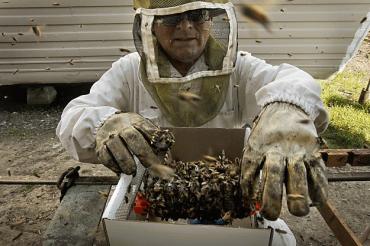
Beekeeper Paulino Dustamante prepares a commercial shipment at Honey Bee Genetics Inc. in Vacaville.

After tumbling to a 23-year low in 2007, California's commercial honeybee population seems to be on the rebound - though a mysterious and deadly epidemic persists in ravaging some colonies.

Apiarists in the state, most of whom rent their bees to farmers for crop pollination, say this and last year's wet winters - and more plentiful greenery - may have helped temper the effects of "colony collapse disorder," a little-understood scourge that has virtually wiped out some bee stocks across California and the United States.

But other beekeepers say they've simply gotten better at compensating for the die-off by dividing their colonies, importing new queen bees or buying whole colonies outright (the number of bees in a commercial colony fluctuates through the year, ranging between about 20,000 and 150,000).

"We're learning new ways to deal with (colony collapse disorder), so the numbers are getting better," said Frank Pendell, president of the California State Beekeepers Association. "It's just like hitting your finger over and over with a hammer. You learn to stop doing it."

The number of honeybee colonies in California is at its highest level in seven years - good news in a state where the black-and-yellow bug represents a critical link in the multibillion-dollar food-production cycle. In their search for nectar, the buzzing insects unwittingly distribute pollen - the equivalent of male sperm - to the female part of plants. Nearly 100 California crops, including melons, sunflowers, carrots, cauliflower and almonds, rely on bee pollination.

The National Agricultural Statistics Service, one of the only state or federal agencies that track honeybees, counted 410,000 colonies in California last year, up from 355,000 in 2009 and a rock-bottom 340,000 in 2007.
Count considered low

In general, the national data under-represent the number of colonies because the annual survey is voluntary and does not include operations that strictly rent their bees for pollination; most industry watchers put the number of California colonies at 500,000 to 550,000.

That remains well below the recent peak of 620,000 colonies in 1989 (the records go back to 1987). Nevertheless, honeybee experts are heartened by what they see as marked improvement in the health of many hives - particularly after the 2007 nadir.

One factor may be Mother Nature. More rain in 2010 and 2011 may have boosted the bees' floral food supply, and lower summer temperatures may reduce heat-related stressors, according to Eric Mussen, a well-known bee authority at UC Davis.

"On the whole it looks like the bees are doing better," Mussen said. "With a little luck, this may be one of our better years."
Cyclical die-offs

The loss of 15 to 25 percent of a colony's bees over a winter is pretty normal, Mussen said. And over the history of apiculture - European honeybees were brought to the United States in the 1600s - mass deaths are not unheard of. Wild bee populations have plunged in recent years due to loss of habitat, and commercially raised bees have succumbed to cyclical die-offs due to a host of diseases and microbes.

Colony collapse disorder - first described in 2006 by a Pennsylvania beekeeper who lost most of his bees after trucking his hives to Florida for the winter - is striking in its devastation. The sickness seems to target the insect's gut, interfering with its ability to take in nutrients. While the disorder culls an average of one-third of each colony's bees in California and the United States, in some cases up to 90 percent of the workers simply fly off and die. Scientists are still struggling to find the culprit - or culprits.

Recent research suggests several causes working in tandem, including dry weather, poor food sources, environmental stress, insecticides, fungi, mites and viruses. Some have even blamed genetically modified crops and cell phone radiation.
Almonds need bees

While scientists continue to narrow the suspects, farmers are keeping a close eye on the bees' fortunes. No product has more at stake than the state's $2 billion annual almond crop.

Each year, the almond bloom in the Central Valley requires about 1.5 million honeybee colonies for pollination, or about half of all the commercial colonies in the United States. Beekeepers charged between $140 and $165 per hive this almond season, Pendell said; one acre typically requires two hives for pollination.

Tom Parisian, who tends 3,500 colonies in Vacaville, has changed the way he rents bees to almond farmers after colony collapse disorder claimed about half of his bees in 2008.

For instance, some growers use pesticides that experts have implicated in the bee plague. On days when farmers spray those chemicals, Parisian removes his hives. It's expensive and time-consuming, Parisian said, but if the tactic helps keep his bees healthy, he's willing to take the hit.

Parisian also supplements his bees' diet with syrup to boost protein levels and treats the colonies with anti-viral medicine.

"You can't tell which one or two things may be having an effect," he said. "But the bottom line is the bees came through last winter in better shape - probably better than they have been in 30 years."

Still, no cure for the disorder exists, and Mussen continues to hear from beekeepers who lose half of a colony seemingly overnight.

E-mail Kelly Zito at kzito@sfchronicle.com.

Read more: http://www.sfgate.com/cgi-bin/article.cgi?f=/c/a/2011/04/10/MN971IRGIA.DTL#ixzz1JhaSQiJv

Wednesday, April 13, 2011

Build the buzz to save the bees

Thanks for helping build the buzz! On April 11, 2011 we sent the 23,986 signatures we collected to the EPA along with a swarm of handcrafted bees that visually demonstrate the massive support for this issue.

If you’d still like to add your name to the petition, you can send a postcard to the EPA directly at this address:

US Environmental Protection Agency
Office of Pesticide Programs (Division 7507C)

Attn: Steven P. Bradbury
Ariel Rios Building
1200 Pennsylvania Ave., N.W.
Washington, D.C. 20460

For updates on the campaign, please join our mailing list »

Tuesday, April 12, 2011

A Rest Stop Keeps Honeybees From Dropping Dead From Overwork

Bee-Station
The United Kingdom's bees are overworked and declining, so Jamie Hutchinson designed landing pads that help them rest and recharge.

After five years of breathlessly freaked-out news reports, nearly all of us have heard of "colony collapse disorder" -- the label scientists have given to a mysterious decline in bee populations observed since 2006. After hearing that a mass die-off of bees would spell certain doom for the human race, designer Jamie Hutchinson felt compelled to do something to help avert the coming beepocalypse.

While the bees' plight almost certainly isn't going to result in the extinction of humanity, his creation -- an adorable little hut called "Bee Station" -- may help reduce the stress on the bee populations in his native United Kingdom.

Hutchinson designed Bee Station as a kind of "truck stop" for the overworked honeybees left pollinating local plants after many of their kin died off. Apparently, these bees are so stressed out that Britons have observed them dropping near-dead on their lawns and sidewalks -- when all they need, says Hutchinson, is a comfy place to rest and recharge with some sugar water. Conscientious bee-helpers could just put egg cups of sugar water in their gardens, but they'd soon get uselessly diluted by rainwater. The Bee Station solves this problem by providing a roof over the exhausted insects' heads.

This isn't some silly greenwashed stunt, though -- Hutchinson did his research, designing his earthenware huts specifically for two species (Bombus pratorum and Bombus horotorum) that seek out similar structures naturally to rest in. The round top shelters the bees from rainwater and stiff breezes, while the "feet" of the Bee Station hold reservoirs of sugar water. At $65 a pop, the Bee Station seems a bit pricey as a way to anthropomorphize insects that'd just as soon sting the sh*t out of you as accept a little TLC. But as GOOD magazine points out, the little buggers' pollinating services are worth $220 billion, so offering a bit of help while they're in a slump can't hurt. And let's face it, a cute white Bee Station would look a hell of a lot better in your flower bed than that stupid gnome you've got now.

Please note: (Comment added by a reader): "This is an interesting project, but this article has one glaring mistake:

"Hutchinson did his research, designing his earthenware huts specifically for two species (Bombus pratorum and Bombus horotorum)..."

Those two bee species that this was designed for are not honeybees, as this article repeatedly suggests. Those are bumblebees! Very different! Hutchinson "did his research", but apparently the author of this piece did not. "